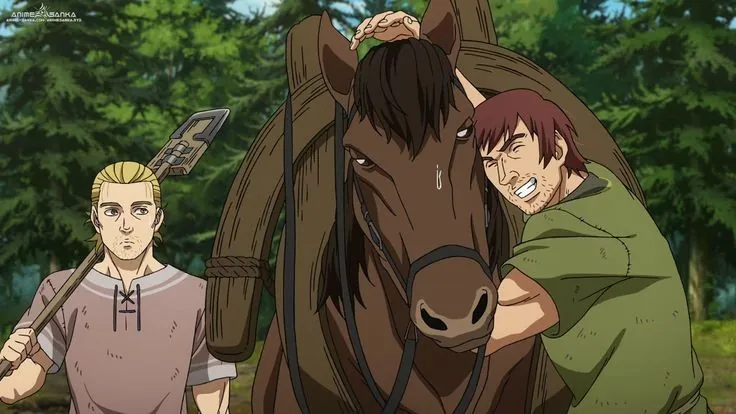
If the first season of Vinland Saga captivated audiences with the kinetic fury of Viking raiding campaigns, the second season—animated with breathtaking emotional sensitivity by MAPPA under the direction of Shuhei Yabuta—executed one of the most daring, magnificent tonal shifts in the history of contemporary anime. Deliberately pivoting away from the blood-soaked battlefields of Anglo-Saxon England, the narrative directs its gaze toward the quiet, wind-swept wheat fields of a rural Danish estate: Ketil’s farm. It is here that the true moral core of Makoto Yukimura’s masterpiece begins: the arduous metamorphosis of an executioner into a human being capable of creating life.
1. The Purgatory of Silence: Thorfinn as an Empty Vessel
The premise of the season is a masterclass in psychological realism. Having lost Askeladd and been traded into bonded servitude on the Danish coast, Thorfinn is no longer the lightning-fast assassin of the battlefield. He is a hollow phantom, an impassive thrall who absorbs blows from overseers and hirelings without flinching—not out of tactical stoicism, but from complete existential detachment. Having ceased to feel love, hope, or fear, Thorfinn does not dread death because he knows his soul died years ago.
Yukimura refuses easy or instantaneous redemption. War trauma is not dissolved by uplifting epiphanies; it manifests as terrifying, recurring nightmares where Thorfinn falls into a bottomless cavern populated by the spectral faces of the countless men, women, and elders whose throats he slit during his youth. These faceless dead cling to his limbs, dragging him down into the subterranean mire. It marks the agonizing birth of moral accountability: the moment an ex-combatant ceases rationalizing his past and feels the full, crushing irreversibility of his atrocities.
2. Einar: The Gaze of the Innocent and the Miracle of Wheat
Into this pit of sterile despair steps Einar, a northern English farmer whose village was torched, whose mother and sister were slaughtered before his eyes, and who has been stripped of his liberty. The profound narrative brilliance of binding Einar to Thorfinn lies in the fact that Einar represents the exact demographic of innocent victims Thorfinn spent his youth generating. Einar knows nothing of Viking honor codes; he knows how to cultivate soil, tend seedlings, honor natural rhythms, and value bread earned through honest toil.
Their burgeoning brotherhood becomes the emotional engine of the narrative. Through the grueling labor of clearing ancient woodland on Ketil’s estate—felling colossal trees trunk by trunk and wrenching stubborn roots from the earth by hand to earn their manumission—Thorfinn encounters creation rather than destruction for the first time in his life. Watching the first green shoots of wheat break through soil they cultivated with their own blistered hands is not mere farming: it is a sacred rebirth. The hands that knew only how to spill blood learn to nourish life.
3. The Fallacy of the Benevolent Master: Ketil and Feudal Decay
One of the season’s greatest philosophical triumphs is its unflinching dissection of Ketil. Superficially, Ketil appears to be a gentle, progressive landlord who offers his thralls a path to buy their freedom and claims to despise gratuitous violence. However, as geopolitical pressure mounts under the approaching shadow of King Canute’s war fleet, Ketil’s benevolent facade disintegrates catastrophically.
Ketil is not peaceful out of moral courage; he is peaceful out of cowardice, personal insecurity, and desperate attachment to his wealth. When his fraudulent reputation as a warrior is challenged and he discovers Arnheid’s escape attempt, the supposedly compassionate master degenerates into an unhinged brute, bludgeoning the woman he claimed to love into a fatal coma. Yukimura demonstrates with unsparing clarity that human subjugation is inherently rotten: there is no such thing as a “good master” within an institution founded on owning human flesh.
4. Arnheid’s Martyrdom and the Crumbling Northern Haven
Arnheid’s tragedy stands as the emotional summit that cleaves the season in two. Ripped from her burning village, separated from her slain infant, and enslaved to Ketil’s desires, Arnheid personifies the silent victims upon whose subjugation all Norse wealth was erected. Her fleeting reunion with Gardar, her war-shattered husband who arrives hallucinating about their lost pastoral paradise, culminates in an unmitigated disaster that underscores the impossibility of finding peace within European feudalism.
On her deathbed, as Thorfinn and Einar weep beside her, Arnheid catches a dying glimpse of a world across the western sea: a warm, green sanctuary where feudal overlords, axes, and slave chains have no dominion. Her passing crystallizes Thorfinn’s transcendent purpose: merely refraining from violence is insufficient; one must sail into the unknown to actively cultivate a haven for those whom society has abandoned.
Kenosis, the Descent into Inner Valhalla, and the Ethics of the Plow
In theology and mystical philosophy, the Greek term kenosis denotes 'self-emptying': the radical stripping away of the proud ego so that a new conscience may be born. Season 2 of Vinland Saga (the Slave or Farmland Arc, set between 1015 and 1018 AD) executes one of the boldest tonal transformations in visual storytelling: replacing the military sieges of England with the quiet of a Danish forest where two slaves, Thorfinn and Einar, fell trees day after day.
Far from being a narrative detour, this agrarian stillness provides the sole psychological space where the ghosts Thorfinn repressed during eleven years of battlefield adrenaline can finally catch up with him. Episode 9 of Season 2 (Manga Chapter 71, titled 'Oath') represents the philosophical heart of Makoto Yukimura's entire oeuvre: trapped inside the nightmare of the true Valhalla—a plain of corpses where warriors hack one another apart for eternity—Thorfinn receives final counsel from Askeladd, who points toward the mountain of men and women Thorfinn himself slaughtered and urges him to climb toward the light.
Awakening in tears before Einar and pronouncing his oath to renounce violence forever, Thorfinn realizes that the dead do not ask him to die; they demand that he sow more wheat and save more lives than all those he reaped.
The second half of the season tests that newborn oath in a crucible of relentless tragedy: Ketil's hypocrisy, the heartbreaking deaths of Arnheid and Gardar, the ethical clash with Snake, and the invasion of King Canute's imperial army. That Thorfinn halts the war not by drawing his daggers anew, but by enduring Drott's hundred punches to speak as an equal with the Emperor of the North Sea, seals the definitive victory of the plow over the sword.
Key Philosophical & Ethical Takeaways
- From Emptiness to Fullness: Being emptied of martial pride through slavery enables Thorfinn to learn empathy, gratitude, and productive labor for the first time.
- Social Microcosm on the Farm: Ketil's estate functions as a philosophical laboratory where property (Ketil), wisdom (Sverkel), duty (Snake), and oppression (Arnheid) collide.
- Redemption as an Infinite Task: The forgiveness Thorfinn earns in this season does not erase his past; it commits him for life to founding Vinland.
5. The Supreme Test: Forgoing the Blade
When Canute’s royal armada storms the beaches and Ketil’s hastily recruited peasant levy is slaughtered in minutes, Thorfinn refuses to draw steel, even when death seems certain. In the iconic standoff against Drott and the royal guards, Thorfinn absorbs one hundred merciless, bone-rattling blows without retreating an inch, proving that radical active pacifism requires physical and spiritual endurance incomparably greater than hiding behind iron weapons.
The subsequent beachfront dialogue between Thorfinn and King Canute represents the ultimate philosophical clash: Canute seeks to build peace through imperial hegemony and calculated tyranny, while Thorfinn chooses exile into uncharted waters to offer an ethical alternative. When Thorfinn quietly tells Canute: “If your kingdom encompasses the entire earth and leaves no sanctuary for the defenseless, then I will flee beyond the reach of your crown,” even the most feared ruler of northern Europe recognizes a truly emancipated human being. Season 2 of Vinland Saga is not merely great storytelling; it is an immortal testament to human dignity, atonement, and spiritual resurrection.