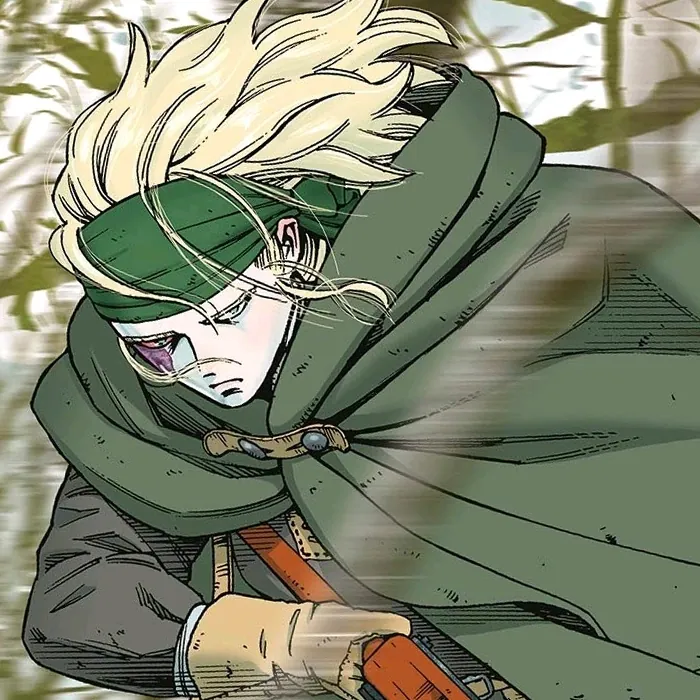
In the vast majority of redemption narratives, the remorseful protagonist is granted an almost comfortably cheap cosmic absolution: it is usually sufficient for him to regret his past misdeeds, shed tears, and embark on a new moral path for the narrative and audience to grant immediate forgiveness. Makoto Yukimura, with an uncompromising honesty that places him among the most rigorous storytellers of our era, steadfastly refused to hand Thorfinn an easy peace. The living, lethal, incorruptible embodiment of that refusal bears a name: Hild.
1. The Ghost Who Asks No Permission
Hild erupts into the narrative amidst the frozen Norwegian pine forests during the expedition eastward. She is no abstract allegory; she is a woman of flesh, blood, and searing agony whose entire existence was incinerated years earlier by Askeladd’s raiding band. The daughter of a brilliant inventor and master carpenter whom she revered, Hild witnessed a teenage Thorfinn slit her father’s throat in cold blood without a flicker of hesitation to plunder their winter provisions.
When Hild reappears, armed with a custom-engineered repeating crossbow and terrifying ballistic precision, she mirrors with chilling symmetry the exact role Thorfinn occupied throughout his adolescence. Just as young Thorfinn trailed Askeladd for a decade to avenge Thors, Hild possesses full moral legitimacy and historical justification to put a bolt through Thorfinn’s heart. She is under no obligation to celebrate her former tormentor’s spiritual “awakening”; to her, Thorfinn remains the monster who turned her childhood into ashes.
2. The Cocked Crossbow as an Ethical Imperative
The pact struck between them is an ethical summit of the entire work. Having listened to Thorfinn’s plea and witnessed his total refusal to draw steel or defend himself, Hild does not forgive him, but grants a conditional armistice: she will journey alongside him, monitor every step with a loaded quarrel, and should Thorfinn ever resort to violence to impose his will, she will pull the trigger without hesitation.
Hild thus becomes Thorfinn’s external, unbribable conscience. In philosophical terms, she embodies Emmanuel Levinas’s ethics of otherness: the face of the victim that arrests our ego and demands relentless accountability. Forgiveness is not a commodity the perpetrator can demand simply because he has repented; forgiveness belongs solely and exclusively to the victim, and the victim retains the sovereign right to withhold it for a lifetime.
3. Retributive Justice vs. Restorative Justice
Through Hild, Yukimura contrasts two irreconcilable paradigms of justice. On one side stands retributive justice, the bedrock of Viking culture: an eye for an eye, blood for blood, a life for a life. If Hild executed Thorfinn, she would satisfy the ancient lex talionis, but leave the world unchanged: one more corpse in the snow and a heart devoured by the exact same hollow ruin that crippled Thorfinn in the prologue.
On the other side stands the restorative justice that Thorfinn proposes and which Hild, with immense skepticism, agrees to test. The only authentic atonement for an executioner is not to die—which is an easy, selfish escape from consequence—but to dedicate every remaining day to creating and protecting as many lives as he once destroyed: clearing farmland, feeding the dispossessed, and engineering a haven where no child will ever have to watch their parents slaughtered in the dark.
Against 'Cheap Grace': Derrida, Bonhoeffer, and the Wooden Scale
In The Cost of Discipleship (1937), the German theologian Dietrich Bonhoeffer coined the foundational concept of 'cheap grace' (billige Gnade): the forgiveness a sinner comfortably grants himself through inward remorse alone, without demanding a costly transformation of life or confronting the actual faces of those he wronged. Similarly, the philosopher Jacques Derrida argued in On Cosmopolitanism and Forgiveness a luminous paradox: authentic forgiveness begins only where it confronts the unforgivable. Had Makoto Yukimura concluded Thorfinn's moral arc on Ketil's farm, his redemption might have risked appearing as a unilateral absolution granted by dream-specters; Hild's entrance in Manga Chapter 116 shatters any temptation toward cheap grace.
Hild is the most haunting symmetrical mirror in the entire series: not only because as a girl she watched an adolescent Thorfinn murder her father (a gentle Norwegian carpenter and inventor) and shatter her family, but because after being orphaned she was taken in by a master hunter in the woods who taught her a dying lesson identical to Thors'—a plea she, blinded by trauma just like young Thorfinn, could not obey.
Her technical genius as an engineer—capable of designing repeating crossbows, mechanical bearings, and improved plows—symbolizes the duality of human intellect itself: the same mind that can craft tools to ease peasant toil is dragged by war into building machines of death.
Consequently, the resolution of her arc in Manga Chapter 191 (deep within the forests of Vinland) is universally hailed as one of the emotional summits of modern graphic literature. After years of shadowing Thorfinn across the Baltic Sea, Greece, and North America, watching her former executioner risk his life daily to prevent war between Norse settlers and the indigenous Lnu, Hild hears the spiritual voices of her father and master hunter and whispers through tears: 'I forgive you, Thorfinn. You are a true warrior.' In that embrace beneath the trees of the New World, victim and perpetrator finally close the wound opened twenty years earlier in the snow.
Key Philosophical & Ethical Takeaways
- Absolute Sovereignty of the Victim: The aggressor's remorse never morally obligates the victim to forgive; forgiveness is always a free, non-demandable gift.
- Technology Redeemed: As Hild travels with Thorfinn's expedition, her mechanical genius shifts from crafting man-hunting crossbows to designing plows and mills for the community.
- Closing Thors' Circle: That Hild herself—the woman Thorfinn orphaned—proclaims him a 'True Warrior' grants his redemption unimpeachable ethical legitimacy.
4. Forgiveness as the Supreme Feat of Will
What makes Hild’s narrative arc profoundly moving is that her relationship with Thorfinn evolves not through rapid melodrama, but through years of silent witness. She watches Thorfinn bleed without retaliating, swallow insults, build ocean-going vessels, shield children with his own body, and honor his pacifist oath on the brink of death. The crossbow resting in her hands gradually transforms from an instrument of assassination into a delicate scale measuring the human soul.
When the fateful moment finally arrives and Hild lowers her weapon to utter the most difficult words a human being can voice—“I forgive you, Thorfinn”—it feels not like a sentimental concession, but like the most staggering moral triumph in the saga. Hild does not merely release Thorfinn from his burden; she liberates herself from the prison of grievance. It stands as the definitive proof that breaking the generational cycle of hatred demands a courage infinitely greater than pulling the trigger.