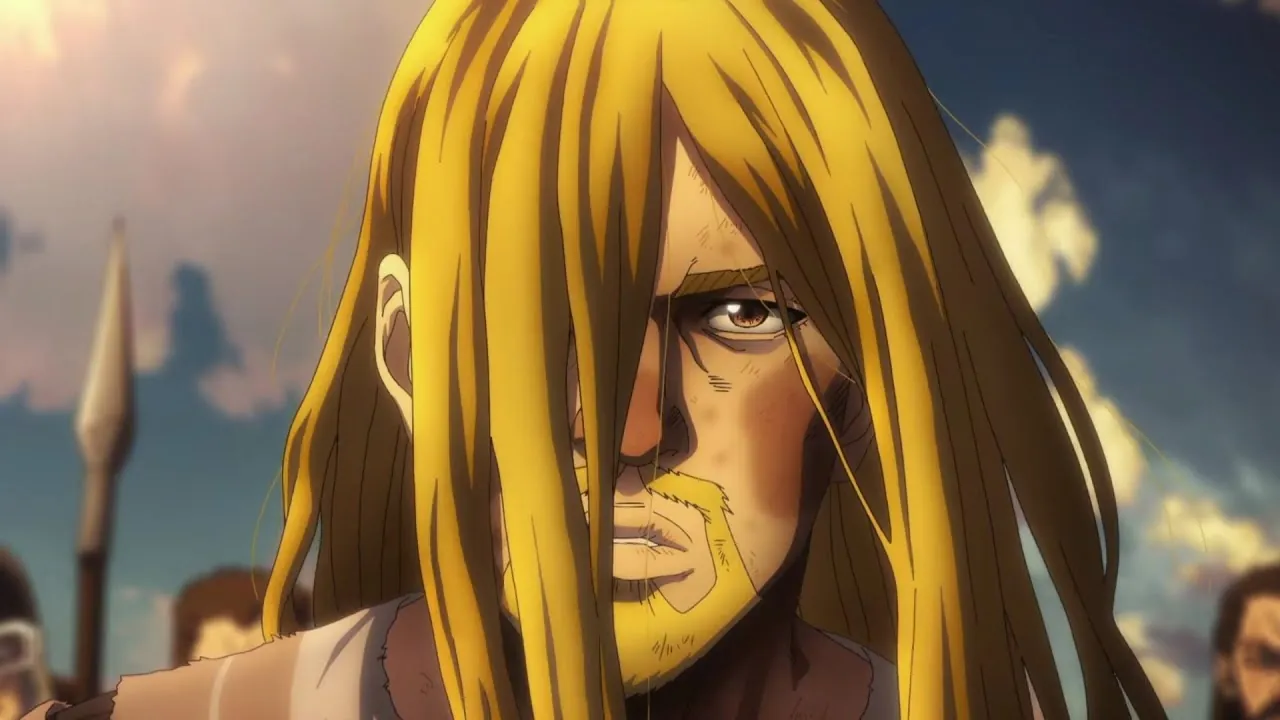
There exists in the collective imagination a widespread, insidious confusion: the equation of pacifism with submission, physical helplessness, or moral cowardice. It is too casually assumed that whoever refuses to retaliate simply lacks the raw capacity or courage to strike back. Few sequences in the annals of modern storytelling have demolished this fallacy with such visceral intensity, dramatic eloquence, and philosophical depth as the trial of the one hundred punches endured by Thorfinn in the climactic episodes of Vinland Saga Season 2.
1. The Crucible of a Barbaric Wager
Following the bloody fall of Ketil’s estate, King Canute is encamped on the shore, surrounded by hundreds of battle-hardened elite royal guards safeguarding the royal command pavilion. Thorfinn—unarmed, dressed in the tattered linen tunic of a freshly liberated thrall—seeks an urgent audience with the young monarch to halt the cycle of slaughter before imperial ambition consumes more innocent lives.
The royal huskarls mock him mercilessly. In Viking culture, a man without steel is viewed as vermin, a disposable weakling to be kicked aside into the muck. It is then that Drott, known as “the Bear-Killer,” an armored behemoth whose physical mass dwarfs Thorfinn’s, proposes a brutal condition: he will grant Thorfinn passage into the royal pavilion only if he can absorb one hundred direct, bare-knuckle blows without dodging, without retreating, and without collapsing into the mud.
2. Martial Mastery in Service of Restraint
What elevates this scene into cinematic and philosophical greatness is that it is not an exercise in passive masochism, but the astonishing deployment of elite martial biomechanics strictly in service of life preservation. Thorfinn is not an amateur who knows nothing of combat: he is a lethal prodigy who fought Thorkell the Tall toe-to-toe and dismantled veteran Jomsviking berserkers before turning sixteen. Had he chosen to break his vow, he could have crushed Drott’s windpipe within a fraction of a second.
Instead of retaliating, Thorfinn uses every ounce of muscle memory, center of gravity, and anatomical understanding to disperse kinetic trauma: tilting his jaw by millimeters at the millisecond of impact, flexing his knees to channel destructive momentum directly down into the earth, and tightening his core to protect vulnerable organs. Absorbing one hundred concussive, bone-rattling strikes from a professional killer while remaining upright on two feet is not an exhibition of passivity; it is a biomechanical and spiritual feat that dwarfs any blind act of aggressive violence.
3. The Gaze that Breaks the Executioner
As the count grinds forward—fifty, seventy, ninety blows—a mesmerizing psychological inversion occurs. Thorfinn’s face swells, his lips split, and blood spatters across the wet earth, yet his eyes remain completely limpid, serene, and devoid of rancor. There is no wrath in his expression, no bitter resentment, nor even arrogant defiance; only adamantine resolve and profound compassion for the men surrounding him.
It is Drott who begins to break down. The man delivering the blows begins to wheeze, tremble, and sweat with unvarnished dread. The circle of watching warriors falls deathly silent. Accustomed to watching victims howl in rage or beg for their lives on their knees, they witness for the first time something their militaristic worldview cannot categorize or conquer: a human being who has transcended the fear of physical pain because his moral conviction is infinitely larger than his own ego.
Satyagraha in Jutland: How the Wounded Body Disarms the Empire
In Mahatma Gandhi's political philosophy, non-violent resistance is never termed 'passivity,' but Satyagraha (literally 'truth-force' or 'soul-force'): the discipline whereby the resister refuses to inflict suffering upon the adversary and chooses instead to absorb the oppressor's violence in his own body until producing a moral short-circuit that disarms the attacker's aggression. The sequence spanning Manga Chapters 95 to 97 (Season 2 Episode 22) stands as the most powerful dramatization of this ethical principle in modern storytelling.
To appreciate the tactical and spiritual genius of Thorfinn's wager before Drott and King Canute's Thegn guardsmen, one must recall the rules of the Viking world: elite warriors are psychologically conditioned to respond to only two behaviors—armed aggression (which unleashes their homicidal training) or cowardly begging (which feeds their sadistic contempt). By accepting the wager to endure one hundred clean punches from a giant capable of killing bears barehanded solely in exchange for an audience with the king, Thorfinn introduces a third response that the soldiers do not know how to process.
Equally revealing is how Thorfinn survives the hundred impacts: he does not stand rigid like a rock that shatters, but repurposes all his former martial mastery to shift a fraction of a second with the vector of each blow, dissipating lethal force without returning a single strike.
When the count concludes and Thorfinn rises to his feet—his face grotesquely swollen yet his gaze serene—to declare before the stunned silence of the camp, 'I have no enemies at all,' a sociological miracle occurs: hardened Viking veterans, moved to the core by a courage that eclipses any berserker's fury, part ranks in reverent awe toward the emperor's tent. For the first time in his life, Thorfinn surpasses his father Thors: he has conquered an army without knocking down a single man.
Key Philosophical & Ethical Takeaways
- Sublimation of Martial Skill: Thorfinn does not discard his warrior reflexes; he inverts them completely to absorb harm rather than inflict it.
- Shattering the Bellicose Frame: By neither attacking nor fleeing, Thorfinn strips Canute's soldiers of any emotional justification to continue beating him.
- Surpassing Thors' Legacy: Whereas Thors had to break the arms and noses of Askeladd's crew in the Faroes, Thorfinn wins peace through strictly bloodless sacrifice.
4. Non-Violence as Active Power
Philosophically, the trial of the hundred punches embodies Mahatma Gandhi’s principle of Satyagraha (“truth-force”) alongside the classical Stoic doctrine that authentic power resides exclusively in total mastery over one’s internal choices. Thorfinn exposes the ultimate truth: the sword is the crutch of the spiritually weak—a tool utilized by those who must artificially amplify their authority because their souls tremble before terror.
When the hundredth blow lands and Thorfinn, battered yet unshaken, meets the soldier’s terrified gaze and calmly asks: “Have I fulfilled the condition? Now take me to Canute,” the moral victory is absolute. Not a single person died; not a single drop of another human being’s blood was spilled; yet Thorfinn has dismantled the psychological foundation of an entire army. He has proven that the strongest human being on earth is not the one bearing the sharpest iron blade, but the one possessing the peerless courage to have no enemies.