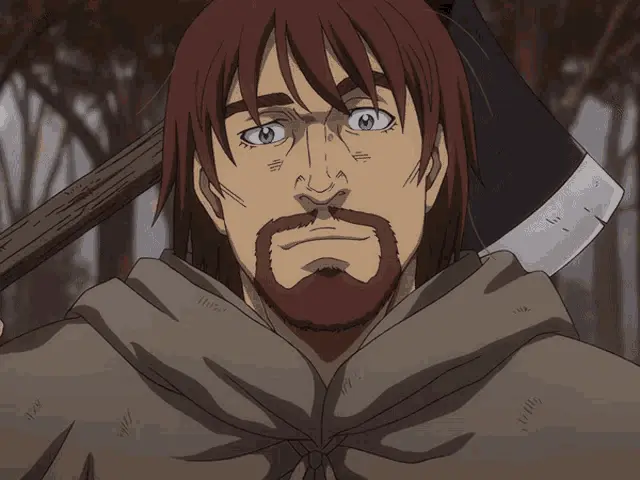
In its second season, Vinland Saga undergoes an extraordinary thematic shift: leaving behind the war-torn battlefields of England, the narrative turns to the quiet woodland of a Danish estate. There, two enslaved youths stripped of legal rights—Einar, grieving the destruction of his English home, and Thorfinn, a hollow shell after ten years of slaughter—are commanded to clear ancient forest to earn their manumission. Through their physical toil, Makoto Yukimura articulates a deeply moving philosophy: the reclamation of labor as the true path to human dignity and spiritual rebirth.
Subverting the Feudal Contempt for Agricultural Labor
To appreciate this arc's thematic power, one must recall the martial hierarchy of the medieval Viking world. Physical agricultural labor was viewed with contempt by the warrior elite, dismissed as drudgery fit only for thralls, women, and the elderly. Authentic honor belonged exclusively to those who seized wealth through warfare and the battle axe.
"Uprooting an ancient oak takes days of blisters and sweat; cutting a man down with a blade takes only a second. But when you bury a seed in the soil and watch the green shoot rise, you realize life is infinitely stronger and more beautiful than all the swords in this world."
Yukimura dismantles this aristocratic prejudice. Through Einar and Thorfinn, the story demonstrates that taking a life requires only animal frenzy or mechanical violence, whereas sustaining life—clearing stubborn roots, turning heavy soil, and nurturing delicate crops—demands far greater spiritual fortitude: patience, humility, resilience, and respect for nature's rhythms.
Einar as the Catalyst for Thorfinn's Healing
Einar's presence is nothing short of providential for Thorfinn. Arriving at the farm in catatonic despair, Thorfinn despises his own existence and passively invites abuse. When Einar learns of Thorfinn's bloody past as a Viking marauder—the very kind of warrior who murdered his family—he is initially consumed by rage.
Yet observing Thorfinn's nightly torment and tears, Einar chooses grace over vengeance. He extends his hand, teaches Thorfinn to plow, and offers unconditional brotherhood. Einar becomes the brother Thorfinn never had: the grounded soul who reintroduces him to the warmth of sunlight, the taste of freshly baked bread, and the value of human existence.
Golden Wheat as the True Symbol of Freedom
The arc reaches its emotional peak when their cleared field yields a golden harvest of ripe wheat. Running his calloused hands through the swaying ears, Thorfinn experiences a joy no battlefield victory ever provided. For the first time in his life, his hands have not spilled innocent blood; they have created sustenance, generated life, and reclaimed beauty from the wilderness.
That harvest represents far more than the silver required to purchase freedom from Ketil; it is Thorfinn's spiritual rebirth. He understands that genuine strength lies not in the sword that robs orphans of bread, but in the arm that guides the plow to feed the community. Communal labor, free from exploitation, forms the essential foundation for building Vinland.
From Iron that Destroys to the Plow that Sustains: The Phenomenology of Labor
The transition between the first and second major arcs of Vinland Saga—explored comprehensively in our study of Season 2 and Ketil's Farm—revolves around a radical reversal in humanity's material relationship with nature. Throughout his adolescence in Askeladd's mercenary band, Thorfinn lived as an economic parasite: he never sowed a single grain of wheat, never felled a tree to raise a roof, and never wove a garment. Vikings contemptuously labeled farmers 'slaves' while depending entirely upon plundering their harvests to avoid starvation.
The arrival of Einar, an Anglo-Saxon farmer from northern England whose mother and sister were murdered during Norse raids, introduces the productive ethics of the soil into Thorfinn's existence. In dialogue with Simone Weil's reflections on physical labor and Hannah Arendt's distinction in The Human Condition between labor, work, and action, clearing the forest on Sverkel and Ketil's estate ceases to be mere servile punishment and becomes an ontological therapy.
Every tree stump uprooted by the sweat of their brows and every stalk of wheat sprouting from the Jutland soil restores to Thorfinn and Einar tangible proof that human hands can create life rather than deal death. By learning how many months of patient toil are required to grow a single loaf of bread, Thorfinn grasps for the first time the monstrous gravity of burning a village in five minutes.
Furthermore, the brotherhood forged between Thorfinn (a former Viking killer) and Einar (a direct victim of Viking raids) represents the series' first genuine historical reconciliation. When their hard-won wheat field is trampled during Gardar's revolt and Canute's invasion, their shared discipline reveals an unbreakable truth: so long as they preserve their lives and the knowledge to till the earth, no army can strip them of the power to begin anew.
Key Philosophical & Ethical Takeaways
- Inverting the Viking Hierarchy: The farmer who produces bread sustains civilization; the warrior who knows only the sword is a sterile dependent.
- Healing Through Matter: Shared physical toil in the forest rescues Thorfinn from traumatic paralysis and teaches him the true cost of sustaining human life.
- Restorative Brotherhood: Einar provides the human mirror Thorfinn needs to transform paralyzing guilt into active responsibility toward the future.
Conclusion: The Victory of the Plow
The brotherhood between Einar and Thorfinn seals Vinland Saga's moral evolution. It demonstrates that redemption is achieved neither through morbid self-punishment nor isolated withdrawal, but through loving service to others. Those who work the earth to feed their fellow man participate in the supreme mystery of creation; their calloused, soil-stained hands are purer than kings' crowns and mightier than conquerors' armies.