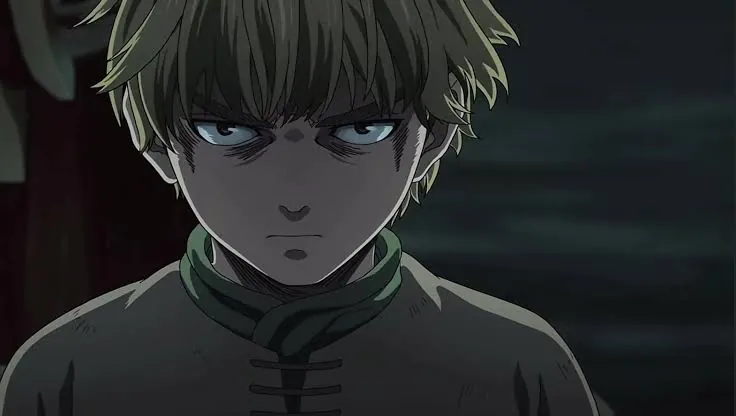
Few narratives in modern visual storytelling execute a subversion as daring, philosophically profound, and utterly devastating as Makoto Yukimura's first season of Vinland Saga. What initially presents itself in the customary armor of a classic historical revenge epic—a prodigiously talented orphan boy surviving in the frozen northern wilderness to avenge the dishonorable death of his legendary father—unfolds with terrifying precision into a surgical autopsy of dehumanization and the complete dismantling of martial glory.
1. The Prologue as a Moral Trap for the Reader
Crucially, Season 1 is not the core of Thorfinn's life; it is what Yukimura explicitly subtitled in the original manga as “The Prologue.” This structural framing is intentional. Over twenty-four episodes of kinetic, high-octane animation produced by Wit Studio, the story deliberately entices viewers with breathtaking combat choreographies, fortress sieges in Anglo-Saxon England, and lethal duels across frozen rivers.
Yet, unlike traditional heroic fiction or common shonen tropes, every acrobatic execution performed by Thorfinn does not advance his moral growth; it plunges him deeper into ethical annihilation. Thorfinn is not a hero in training; he is a broken shell, a living corpse whose sole motivation for drawing breath each morning is a consuming furnace of resentment that has obliterated every ounce of empathy, family warmth, or curiosity. The lethal dual-wielding assassin cutting throats in the snow is, in reality, the most helpless captive on the battlefield.
2. Askeladd: The Master Puppeteer and the Mirror of Civilization
The gravitational core of this first act belongs not to Thorfinn's innocence, but to the tragic psychological and political complexity of Askeladd. The illegitimate son of a ruthless Danish warlord and an enslaved Welsh princess claiming descent from King Arthur, Askeladd embodies total existential disenchantment. He detests the Vikings with every fiber of his being, mocking their barbaric bloodlust and childish worship of Valhalla, yet commands a band of Norse marauders with peerless tactical brilliance because he recognizes the governing reality of his epoch: those who refuse to master violence will inevitably be pulverized by it.
The relationship between Askeladd and Thorfinn stands among the most twisted, mesmerizing father-son dynamics in world literature. Askeladd is simultaneously the butcher of Thorfinn's beloved father, his military commander, an unwilling mentor, and, paradoxically, his truest guardian. Recognizing Thorfinn's blind obsession with the Norse warrior code, Askeladd dangling the carrot of a legitimate duel to manipulate the boy into undertaking suicidal vanguard reconnaissance. Blinded by hatred, Thorfinn willingly becomes the most obedient soldier to the man he despises above all else.
3. The Decomposition of Martial Honor
Throughout King Sweyn's brutal military campaign alongside warlord Floki in England, Yukimura strips away every romantic illusion surrounding the Viking era. These warriors do not fight for transcendent ideals or community protection; they murder for silver, stale ale, and the savage privilege of burning defenseless agrarian hamlets, laughing over the charred remains of broken families.
Characters such as Thorkell the Tall epitomize this grotesque moral void: a jovial giant for whom war is an endless amusement park. When Thorkell witnesses his comrades slaughtered or cleaves cavalry horses in two, he feels neither malice nor patriotism—merely an insatiable boredom that demands temporary relief through adrenaline and severed limbs. Season 1 exposes how an entire civilization institutionalized psychopathy as the apex of masculine virtue.
4. Canute's Awakening: The Death of Naive Love
The structural pivot of the season arrives with Prince Canute's metamorphosis. Initially introduced as a frail, terrified youth hiding behind Christian prayers and the stern protection of Ragnar, Canute is cast into the existential abyss after Askeladd orchestrates Ragnar's murder.
In the biting snow of the English countryside, guided by Father Willibald's drunken theological musings, Canute experiences a tragic revelation: if God has abandoned this mortal sphere to senseless slaughter and unconditional love does not exist among living men, then earthly kings must bear the crown of thorns. Canute forsakes heaven to engineer a kingdom of peace on earth through the calculated, merciless exertion of political power. He becomes a pragmatic sovereign who accepts that forging stability among Vikings requires staining his own hands with more blood than anyone else.
Genealogy of Resentment and the Tragic Structure of 'The Prologue'
In On the Genealogy of Morality, Friedrich Nietzsche warned of the corrosive power of ressentiment (vengeful resentment): unlike creative action born from a free affirmation of life, the man of resentment exists solely as a reaction to an external wound; he desperately requires an enemy to hate lest he collapse into his own emptiness. The fifty-four chapters comprising the first arc of Vinland Saga—traced chronologically from 986 to 1014 AD in our Reading Guide & Historical Timeline—constitute the most unflinching study of resentment ever brought to animation.
To measure Yukimura's formal audacity, one need only observe how he inverts the classical Bildungsroman (coming-of-age narrative). In conventional adventure fiction, the orphaned youth who trains with twin daggers to avenge his murdered father ascends step by step toward moral maturity until defeating the villain in the climax. In Season 1 of Vinland Saga, every duel won by Thorfinn—from his first decapitation in East Anglia to his clash with Thorkell—marks a spiritual amputation and a deeper betrayal of Thors' memory, culminating in the devastating episode where an English Christian mother shelters a wounded Thorfinn like a son moments before he signals Askeladd's band to burn and slaughter her village.
Throughout this decade of carnage, Thorfinn learns nothing of farming, navigation, or human empathy; his entire humanity is contracted to the point of a blade.
By dropping the curtain in the royal hall of York with the explicit title 'End of the Prologue', Yukimura reveals that for twenty-four episodes the true historical protagonist was Askeladd, while Thorfinn remained merely a witness chained to his executioner's shadow. The daggers clattering onto the blood-soaked floorboards of York are not the end of a tragedy; they are the necessary condition for an existential tabula rasa. Only when the idol of vengeance perishes without granting satisfaction can the true story of a human being begin in Season 2.
Key Philosophical & Ethical Takeaways
- Subverting the Action Genre: Thorfinn's martial virtuosity is framed visually as a tragedy of childhood dehumanization, never as a heroic triumph.
- Triad of Symbolic Fathers: Thors embodies the ethical ideal (the plow), Askeladd political reality (the tactical blade), and Leif Erikson persevering hope (the open sea).
- The Void Beyond Vengeance: Askeladd's dying question ('How will you live your life after I am dead?') exposes the utter sterility of hatred as a life project.
5. The Climax at York: The Collapse of the Void
The final banquet in York seals the fate of every central player. When King Sweyn threatens to ravage Wales—the sole sacred relic in Askeladd's soul—the commander makes his ultimate gambit: feigning madness, he decapitates the Danish sovereign before the entire court and surrenders his own life so that Canute may claim the throne undisputed.
And it is precisely there that Thorfinn suffers spiritual devastation. As Askeladd lies bleeding out and Thorfinn clutches him in frantic desperation, there is neither triumph nor closure. Askeladd denies him the duel, asking the question that shatters Thorfinn's reality: “What are you going to do now, Thorfinn? After I die... how do you plan to live your life?”
Thorfinn has no answer. He knows nothing other than killing for revenge. With Askeladd dead by Canute's hand, the single axis that sustained Thorfinn's physical and mental existence evaporates. The blade slips from his trembling fingers. Falling to his knees, screaming into the empty hall, Thorfinn is left without hatred, without a past, and without a future. The season closes on its most poignant image: Thors's twin daggers spinning across the wooden floorboards, reflecting the blank face of a boy who murdered his own soul for nothing.